The Roman Empire is Over!
We need to rename our planets. For the divine feminine to truly shift, we need to rename them and evolve our myths. We are still living under the Roman Empire. The names of the planets Mercury, Venus, Mars, Jupiter, and Saturn are all named after Roman deities, while Uranus and Neptune are named after Greek gods. And the feminine goddess asteroids… Juno, Vesta and Ceres are Roman, while the asteroid Pallas is Greek – an epithet of Athena.
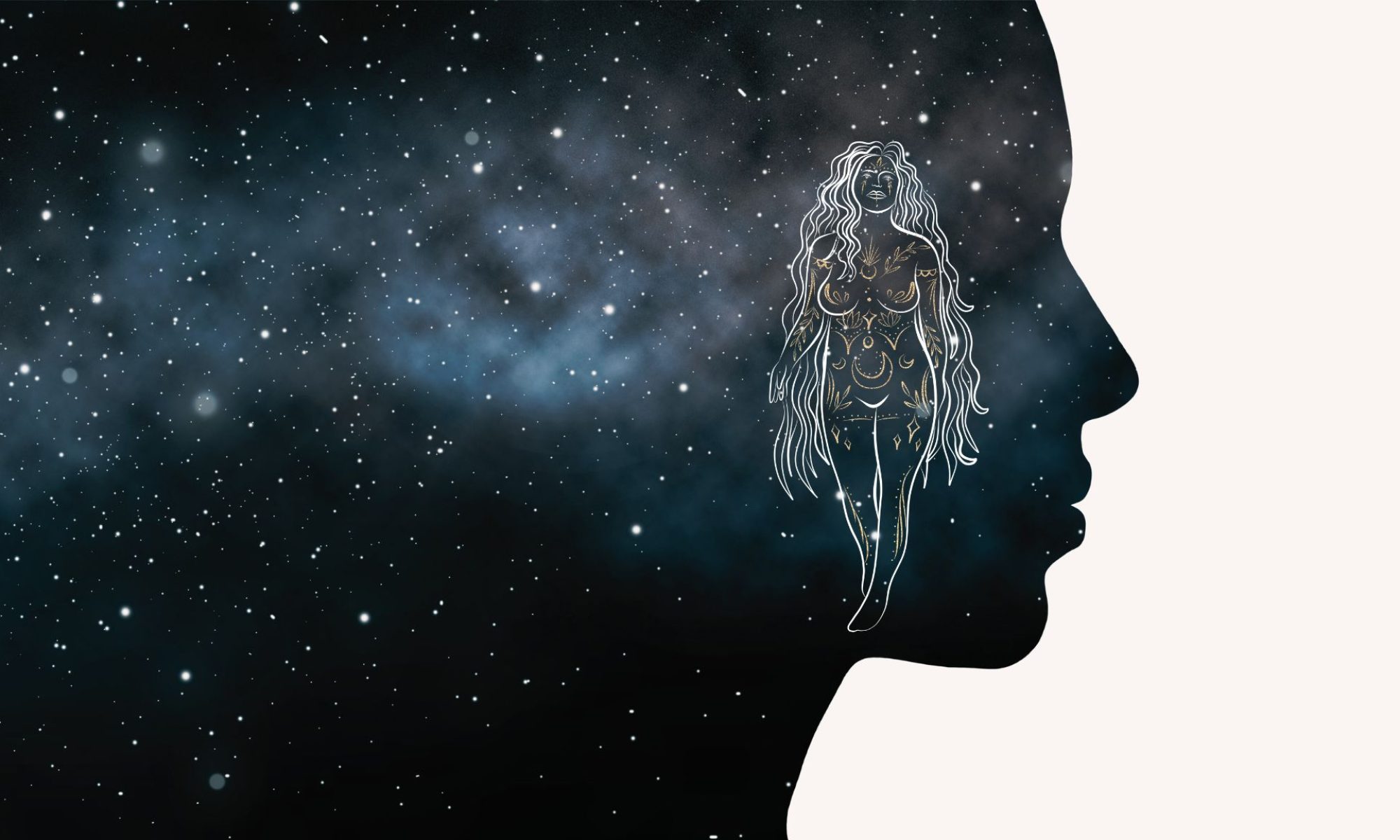
We need to reintegrate the divine Feminine, upgrading our myths and renaming our Planets!
The goddesses in Greek myths were slightly better than Roman myths. In the Roman version of the myth, as told by Ovid, Medusa was a beautiful mortal woman and a priestess of Minerva (the Roman equivalent of Athena). When Neptune (Poseidon) raped her in Minerva’s temple, the goddess punished Medusa, not Neptune. She turned her hair into snakes. This story of Medusa being punished by Athena does not appear in early Greek sources and is not part of original Greek mythology. In the earliest Greek accounts, Medusa is one of three Gorgon sisters, born monstrous and yet a protector of the Virgin goddesses. There is no mention of her being beautiful, a priestess, or being transformed by Athena. To me the evolution (or rather devolution) of the myth simply reflects a continuing and deeper descent of the goddess. Add in rape and victim shaming, and the destruction of the feminine during the Roman Empire is almost complete.
This isn’t just Athena/Minerva, but all of the goddesses. We’ve been in a long cycle of descent – dark age – or as the Vedic tradition calls it, Kala Yuga. Before that, the goddess was empowered. Over time, she devolved; The Greek goddess was divided, the Roman goddess divided and conquered, and the Roman Catholic Virgin, divided, conquered, no longer a goddess and parts of her completely invisible.
There are many myths tell us this would happen. One of my favourites, Amaterasu, is about the Japanese Sun god. She symbolizes light, order, and stability. Her brother, Susanoo, a storm god (Mars), started to act badly and disrespected Amaterasu. Hurt by his actions, Amaterasu hid inside a cave, throwing the world into darkness. To get Amaterasu back out, the gods hatch a plan. They threw a party to create interest and they put a mirror up so that she would see herself and come out of the cave. When she did, they sealed the cave door so that she could not go back in! This story is often told to depict the seasons of the year, but it is also an indication of what happens during the great year. In the descent, we face a time when the goddess is disrespected and hidden.
Three very deep and transformational themes emerged during the February eclipse that hit my ascendant and Sun…. all of them touch a disjointed and broken goddess within. My experience was both deeply personal and transpersonal… It may be for the simple fact that the eclipse and my ascendant are in Aquarius, the sign of humanity. These experiences have led me to the conclusion that I/we must evolve the myths and reclaim and re-integrate the divine feminine archetype… as above so below. As within, so without!
My experiences:
- The first had to do with Sati
- The second with Athena and Medusa
- The third with Albion
Before I go any further, I want to reinforce something. The work that we do on ourselves evolves our planet. Sharing the work that we do on ourselves helps others to make connections and is part of the work. It’s not self-indulgent. It’s important. share, share share….
Here is my share:
Sati
The first theme, having to do with Sati, brought me back to a past life love and a curse I had placed on myself. I vowed to never marry again. I made this vow as I met my death (in my past life) as ultimate devotion and wifely duty to my deceased husband. It was a practice that was justified by the myth of Sati, who immolated herself in protest of her father’s disrespect toward her husband, Shiva. This was her choosing, though, and the goddess was never widowed. In fact, it was Shiva who was widowed in the original tale. Sati is a similar tale to Amaterasu in that when Sati dies, Shiva’s (the Mars character’s) dance causes distruction across the world – So does Susanoo actions during Amaterasu’s time in the cave. In the Hindu tale, Sati’s body is divided up into 51 pieces and she is honours in 51 locations dedicated to different parts of her body.
Now, we may be more familar with the number 72 being spoken about in relation to precession – the number of years it takes for the equinox to precess a degree. But in arc sec (a different form of measurement), it is 51.
The practice of Sati, lost it’s connection to the divine goddess and became a forced practice during our descent. At the heart of it was a society that had completely devalued women and didn’t want to care for a widow. For me, it was a past life expereince that set up karma in my life (and natal placements) that required me to never sacrifice myself again. To avoid too much astrospeak, the placements are in the footnotes1. It manifested in the reemergence of a past life love, who was the husband I had had committed Sati for. Sati became only associated with the practice… A word that became yukky… But through my recent expereince, I reconnected with a Sati who is primordial and powerful.
Sati reicarnated to be rejoined with Shiva… she came back as Shakti! Or course she did… that is the cycle of precession. But let us not forget about the fullness and power of her first incarnation as Sati!
The Virgin
The second theme had to do with the same past love, but focused on the vow part of the story – to never marry. It brought in themes of the Virgin goddess2. Athena was not born of a woman; instead, she was born out of the head of Zeus. To hold boundaries and be respected, she needed to align with the patriarchy and become a Virgin. Athena was not the only Virgin; the others were Diana/Artemis and Vesta/Hestia. Virginity allowed them to maintain autonomy and resistance to patriarchal control and so-called masculine qualities… but at a cost. Alone – unmarried and celibate.
A woman’s power is her power to create… even more powerful when she can also destroy. With the Virgin goddess she lost her power to love and create.
Now I mentioned before that I have Athena and Minivra conjunct my descendant, and Pallas conjunct my Ascendant. The archetype is who I am and who I am in relationships (or non-relationships). I’ve not been married, I have no children, and my sex life is ascetic (if you care to know). When the eclipse hit my ascendant/descendent and Uranus, sitting on the fixed star Algol associated with Medusa, square it, it was Minevera, not Medusa, who took my hair (Yes, I had a serious hair accident). Worse… the asteroid Medusa was conjunct her lover (or rapist) Neptune in my solar return… it mattered not to Minerva if Medusa was loved or raped, Minerva punished. So when a past life love showed up in my life… she made me pay.
It was something split off and divided within me! The broken goddess within.
Out of this came the realization that the Virgin (Pallas/Athena/Minerva) is in deep need of healing – within me and within society.
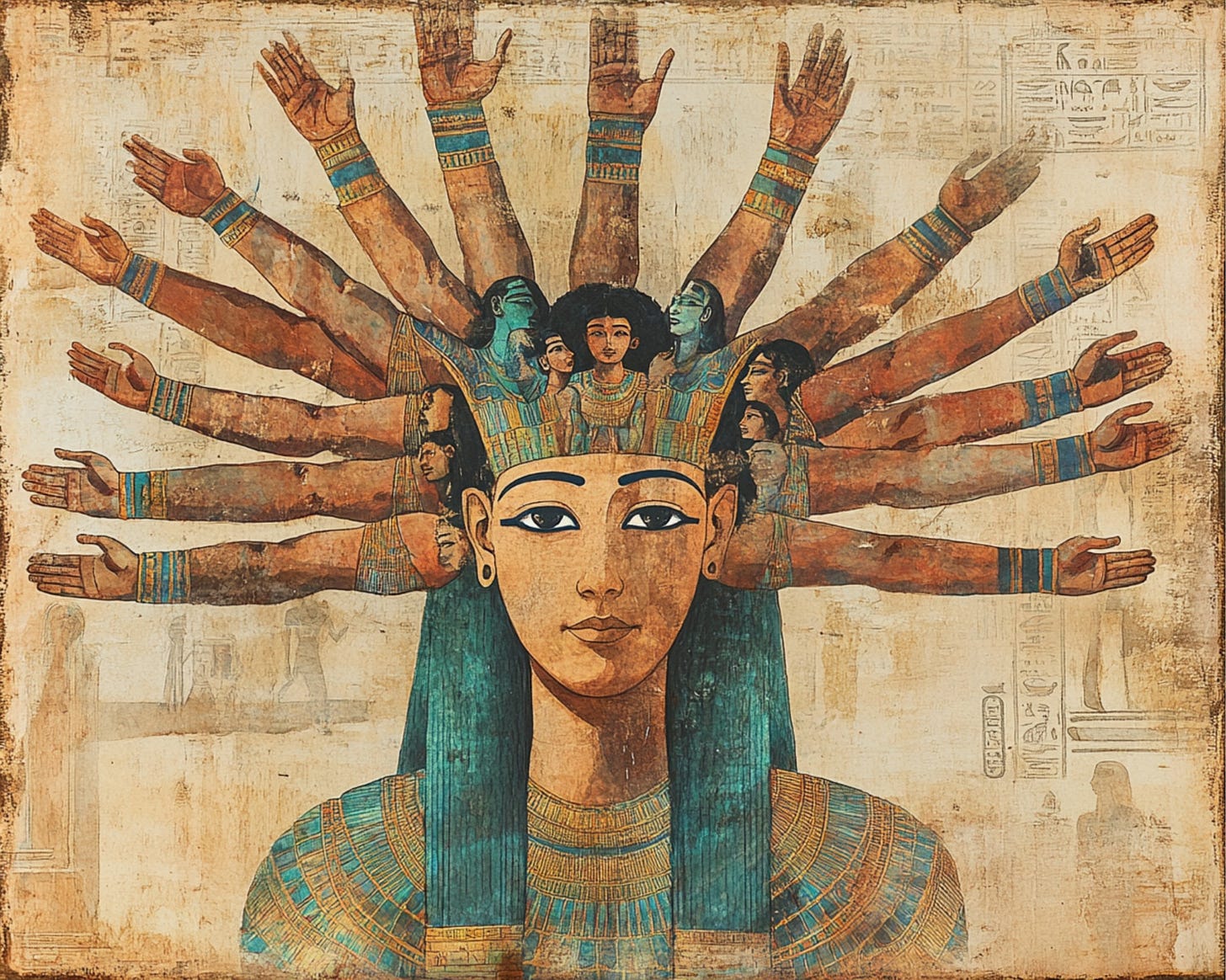
Athena’s older Egyptian counterpart, Neith, was creatress; she had no parentage. She was the consort of two men, and she had children, one of them RA (the Sun). Like Athena, she weaved, like Athena she was a warrior goddess. She was compared by the Greeks to Neith, but as Greek and Roman times came about, she was stripped of her sexuality, her cosmic creativity and her primordial status. Athena’s divorce from her sexuality and cosmic creativity occurred from a descent into the masculine mind…While Athena was syncretized with Neith, the Virgin Diana was syncretized with the Egyptian Satis, also called Sati. She was the goddess of the Nile river, with her name meaning she who pours (from jars) and she who shoots (from arrows). In fact, Neith and Satis were the same goddess; Neith was the goddess of Lower Egypt, and Satis was the same goddess who ruled Upper Egypt. Neith and Satis embodied the warrior, strategy, firey aspects of goddess, and were love, sexuality, and creativity.
Interesting to note that Neith and Satis were both partnered with Khnum, who, on his potters wheel, created humanity3. Neith’s temple in Sais bore the inscription: “I am all that has been, and is, and shall be. No mortal has yet been able to lift the veil that covers Me.” This sounds so close to the patriarchal God of the Bible, “I am that I am”.
Interesting to also note that the Virgin did not exist prior to Greece and Rome.
Albion
I mentioned a third theme. The third theme was Albion. The Asteroid Albion is conjunct my ascendant. If you have read my posts in the past, you will have become familiar with William Blake’s tale and prophecy of Albion. Albion was a giant who was fully integrated Masculine and Feminine – but fell and divided. In William Blake’s mythology, Jerusalem is the emanation of Albion representing his feminine counterpart, the divine city, and the embodiment of liberty, forgiveness, and spiritual wholeness. In the fall, this became separate. The prophecy involved a reintegration of all parts of Albion in order to become whole again.
Albion is also the name for Great Britain.
I came to Britain last summer and bought a campervan. I had planned to travel and teach astrology, but in a strange eclipse-on-my-ascendent-and-sun turn of events, I ended up with a flat in Oxford. Due to unforeseen circumstances, I had to cancel the first and will likely need to cancel the second Astrology in the Wild – Dark Sky camping experiences. Nothing in my astrology spelled out financial trouble, yet I expereince a sucking on my finances into what can only be described as a black hole. But eclipses are fated, karmic and life changing… in fact, when I started to do the “right” things… the things I guess my guides needed me to do… There was all the money in the world. Doing the wrong things left me stranded, broke and forced to find my way to the right things.
To Oxford…. The navel of England! The navel of Albion! “Permanantly”. Did I mention I have the asteroid Albion exactly conjunct my ascendent?
What is so significant about the middle of Albion? In the old Mabinogion Welsh tales, the red and the white dragon were wreaking havoc across the land. In the myth, the for to return the land to balance, the king needed to find the center of England and subdue them in a large pot of honey mead. That center was measured to be Oxford.
Dragons have many meanings, but in my world, they are mostly related to the energy ley lines in the earth. As it were, those ley line maps are laid out in a book called The Ancient Paths: Discovering the Lost Map of Celtic Europe by Robb Graham. In it, Graham lays out that Oxford was not just the cosmic centre, aligned to the solstices, but also the economic centre from the time of the Gauls.
If this were not true, a portrait of Queen Elizabeth I, standing on a map of England with Oxford between her feet, would not exist. If it were not true, perhapse Oxford would not be the first 15 minute city.
Now the Romans wiped out the Gauls completely. Records of their knowledge of the stars and their ley lines remain only in the war records of Ceaser in Commentarii de Bello Gallico (Commentaries on the Gallic War) and in the alignment of stone.
About the portrait: The famous painting of Queen Elizabeth I standing on a map with Oxford between her feet is said to be an apology painting. It’s Queen Elizabeth I showing her forgiveness for Sir Henry Lee, who had been living with his lover Anne Vavasour. However, the painting is powerful and cosmic.
But let’s not forget that Queen Elizabeth l was the Virgin Queen.

In the painting called The Ditchley portrait, Elizabeth, wears an armillary sphere earing; An armillary sphere consisting of rings, centered on Earth or the Sun, that represent lines of celestial longitude and latitude and other astronomically important features, such as the ecliptic. This earring is said to signify her divine power. In the background are storm clouds and thunder on one side and the sun on the other. The Latin inscriptions on the painting read:
She gives and does not expect (this is written on the sunny side of the portrait)
She can but does not take revenge (this is written in the thunder clouds)
In giving back she increases (this is written on the land)
But she is a woman, and for her to have that much power… she needed to be a Virgin. Elizabeth wears a white dress covered in pearls, which is said to represent her virginal purity. Elizabeth doesn’t hold a sceptre; she holds dainty gloves, a feminine-approved symbol of her power. The image of the Virgin Queen maintained the patriarchy. Yet the painting points to a hiding fullness of feminine power.
Cosmically and astrologically, the light is associated with the Sun and thunder with Mars. In the Tychos model, these two are in overlapping orbits – binary stars.
The Ditchly was painted circa 1592 and the cosmic power of the Sun and Mars can’t be avoided. I’m always looking for hints that the Tychos was known in older days – it was in 1588 that Tycho released his model in De Mundi Aetherei Recentioribus Phaenomenis. Copernicus released his book De revolutionibus orbium coelestium in 1543. The model of the solar system was a hot topic, one which was both discussed and avoided. Discussed as it was obviously associated with divine power and was avoided to avoid heresy with the Church. There is also a sonnet in the painting. The Sonnet in the painting reads:

The power comprises the sun and thunder, which are “correspondencie” with the power and grace on earth. How Hermetic!
If where she stands is a nod to the old Welsh Celtic tale – it speaks of the two dragons subdued in Honey Mead – Honey mead the product of bees were linked to many of the goddesses. Maybe the oldest was Neith – Neith’s temple in Sais was known as the “House of the Bee,” and she was often depicted wearing a crown or holding symbols linked to the insect, embodying wisdom, war, and fertility.
Perhaps it is at the centre of Albion, the centre of England, the place where the two dragons were subdued, that healing can occur. The red and white dragon, the red and white rose (the tudor rose), the divided masculine and feminine of the cosmos and of Blakes’s Albion are joined.
Perhaps Albion is where I find my integration…. And were I start a petition to rename the planets… taking down the Roman Empire once and for all! Where the Myth are evolved to bring the goddess back to her full power!
Asteroids in this article are:
- 881 Athene
- 93 Minerva
- 2 Pallas
- 1122 Neith
- 9438 Sati
- 15760 Albion
Cut and paste into Astro.com to find your placements: 881,93,1122,9438,15760